Description
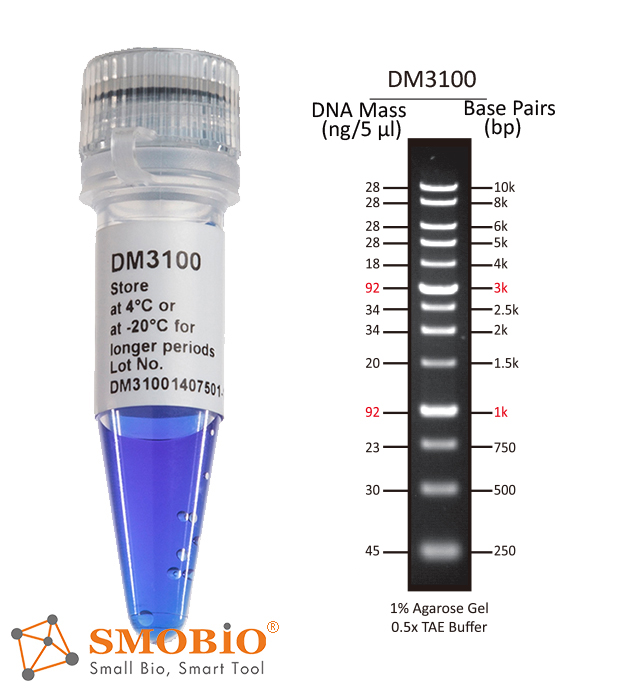
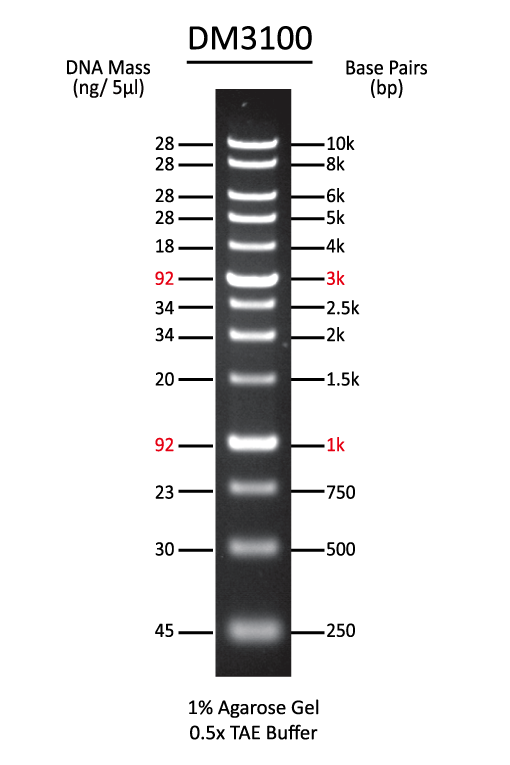
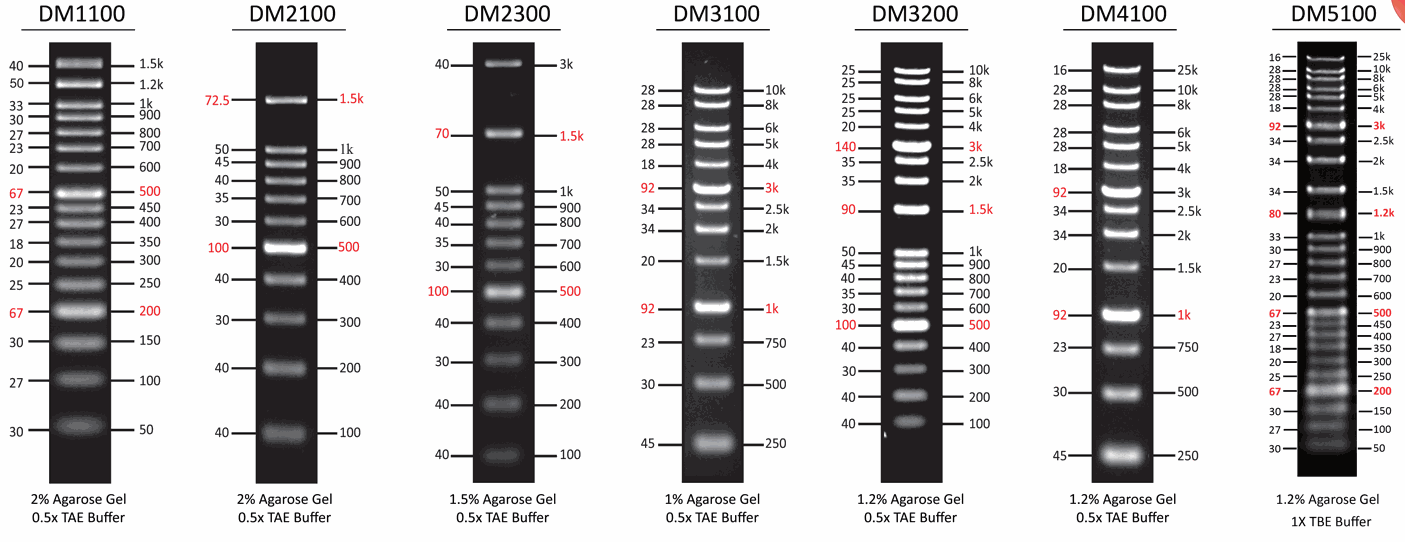
The DM3100 ExcelBand™ 1 KB (0.25-10 kb) DNA Ladder is a ready-to-use DNA ladder, which is pre-mixed with loading dye for direct gel loading. The DNA ladder DM3100 is composed of 13 individual DNA fragments: 10k, 8k, 6k, 5k, 4k, 3k, 2.5k, 2k, 1.5k, 1k, 750, 500, and 250 bp derived from a mixture of PCR products and specifically digested plasmid DNA. This product contains two enhanced bands (3 kb and 1 kb) for easier reference. In addition, two tracking dyes, Xylene cyanol FF and Bromophenol blue which mimic the migration of 4,000 bp and 500 bp dsDNA during electrophoresis are also added for real time monitoring.
Features
Sharp bands
Quick reference— enhanced bands
Ready-to-use— premixed with loading dye for direct loading
Stable— room temperature storage over 6 months
Source
Phenol extracted PCR products and dsDNA digested with specific restriction enzymes, equilibrated in 10 mM Tris-HCl (pH 8.0) and 10 mM EDTA.
Range
250 ~ 10,000 bp
Concentration
50 µg/ 500 µl
Recommended loading volume
5 µl/ well
Storage
Room temperature for 6 months
4°C for 12 months
-20°C for 36 months
Specification
Cat. No. | DM3100 |
Series Name | ExcelBand™ |
Product Size | 500 μl |
Size Range | 250 – 10000 bp |
Band Number | 13 |
Tracking Dye | Bromophenol blue |
Enhanced Band | 1000 and 3000 bp |
Are the DNA markers/ladders produced by SMOBIO sufficient in quantity?
Yes, all the DNA markers of SMOBIO have been passed in the QC processes including repeated optical density measurements to ensure the quantity of total DNA.
Are the SMOBIO's DNA markers/ladders compatible to radio-labeling (for example, label DNA with T4 Polynucleotide Kinase)?
We do not recommend to do the labeling reaction directly.
The reasons are as follows:
Our DNA marker is pre-mixed with loading buffer that contains Tris-HCl, EDTA, and glycerol, may affect radio-labeling.
Our DNA marker is a mixture of PCR products and restriction enzyme digested DNA fragments. Digested dsDNA may still have phospho-group on their 5' end.
To enhance the efficiency of the labeling reaction, here are two steps suggested being done prior to the labeling reaction:
Purify DNA marker by EtOH precipitation or DNA purification kits to remove loading buffer.
Remove phospho-group by using phosphatase, ex CIAP (Calf intestinal alkaline phosphatase)
Are SMOBIO's DNA markers/ladders suitable to use in DNA PAGE?
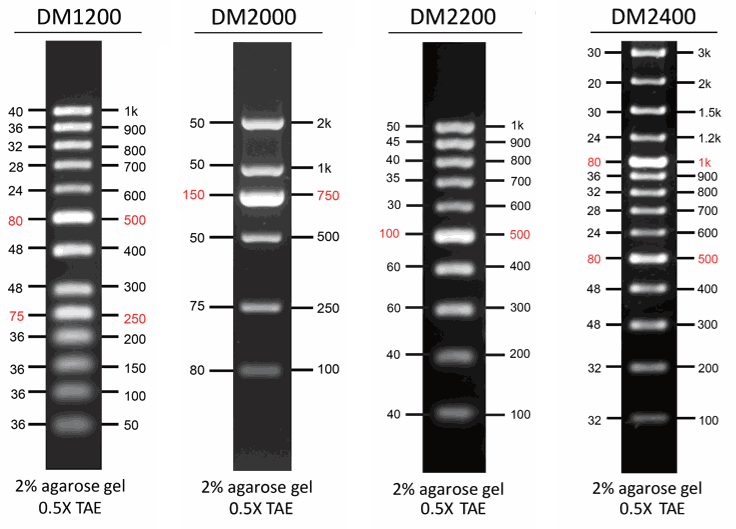
SMOBIO's AccuBand™ series DNA markers (DM1200, DM2000, DM2200 and DM2400) are suitable for DNA PAGE.
Why DNA markers/ladders are resolved two bands at the same size when using high percentage agarose or polyacrylamide gel?
DNA fragments with identical in size are indistinguishable on agarose gels, but, on acrylamide gels, even slight differences in DNA sequence can lead to noticeably different migration rates. To provide increased intensity of DNA marker/ladder bands, multiple DNA fragments with identical in size but different in DNA sequences are used. SMOBIO's AccuBand™ series DNA markers (DM1200, DM2000, DM2200 and DM2400) are more suitable for DNA PAGE.
Are SMOBIO's DNA markers/ladders suitable to use in denaturing DNA PAGE?
SMOBIO's AccuBand™ series DNA markers (DM1200, DM2000, DM2200 and DM2400) are suitable for DNA PAGE.
SMOBIO's AccuBand™ DNA markers are not at denatured form, therefore, you need to denature DNA ladder by yourself.
Here is the protocol to denature DNA ladder:
Mix 5 μL of DNA Ladder with an equal volume of denaturing solution [95% (v/v) formamide, 10 mM EDTA (pH 8.0), 0.1% (w/v) bromophenol blue, 0.1% (w/v) xylene cyanol].
Incubate at 70°C for 5 minutes.
Electrophorese the sample in a denaturing polyacrylamide/urea gel
PMCID: PMC13547285
The arginine synthetase pathway is responsible for carbamoyl phosphate synthesis in Thermococcus kodakarensis
Michimori Y, Ohashi N, Szymanski C, Atomi H. Front Microbiol. 2026 May 29;17:1761990. doi: 10.3389/fmicb.2026.1761990
PMCID: PMC13260591
Novel bioinformatics approaches to design epitope-based vaccine against HIV latency by inquiring CTL epitopes and built-in adjuvants
Mashhadi Abolghasem Shirazi M, Hanan M, Arashkia A, Sadat SM. Sci Rep. 2025 Sep 25;15(1):32809. doi: 10.1038/s41598-025-17196-7
PMCID: PMC12464155
Molecular characterization of invasive Aedes albopictus (Diptera: Culicidae) populations in northwest Iran: Insights into origin, insecticide resistance, and Wolbachia infection
Ghavami MB, Naseri Karimi N, Naghiloo M. Parasit Vectors. 2025 Oct 29;18(1):440. doi: 10.1186/s13071-025-07083-5
PMCID: PMC12573953
Novel bioinformatics approaches to design epitope-based vaccine against HIV latency by inquiring CTL epitopes and built-in adjuvants
Mashhadi Abolghasem Shirazi M, Hanan M, Arashkia A, Sadat SM. Sci Rep. 2025 Sep 25;15(1):32809. doi: 10.1038/s41598-025-17196-7
PMCID: PMC12464155
Cadmium removal and indole acetic acid production by ureolytic bacteria isolated from rhizosphere soils
Adarme-Duran CA, Castillo E, Brandão PFB. World J Microbiol Biotechnol. 2025 Aug 8;41(8):302. doi: 10.1007/s11274-025-04482-9
PMCID: PMC12334442
Optimizing fungal DNA extraction and purification for Oxford Nanopore untargeted shotgun metagenomic sequencing from simulated hemoculture specimens
Nattapong Langsiri, Wieland Meyer, Laszlo Irinyi, Navaporn Worasilchai, Nuttapon Pombubpa, Thidathip Wongsurawat, Piroon Jenjaroenpun, J Jennifer Luangsa-Ard, Ariya Chindamporn. mSystems. 2025 Jun 17;10(6):e0116624. doi: 10.1128/msystems.01166-24
PMCID: PMC12172461
Enhanced non-viral gene delivery via calcium phosphate/DNA co-precipitates with low-voltage pulse electroporation in NK-92 cells for immunocellular therapy
Che-Yung Kuan, I-Hsuan Yang, Chia-Ting Chang, Zhi-Yu Chen, Jhih-Ni Lin, Wei-Ting Kuo, Yu-Ying Lin, Andrew Yueh, Feng-Huei Lin. APL Bioeng. 2024 Aug 6;8(3):036107. doi: 10.1063/5.0198191. eCollection 2024 Sep
PMCID: PMC11315581
Foreign DNA detection in genome-edited potatoes by high-throughput sequencing
Shuhei Yasumoto, Toshiya Muranaka. Sci Rep. 2023 Aug 9;13(1):12246. doi:10.1038/s41598-023-38897-x
PMCID: PMC10412624
TFIID dependency of steady-state mRNA transcription altered epigenetically by simultaneous functional loss of Taf1 and Spt3 is Hsp104-dependent
Ryo Iwami, Naoki Takai, Minenosuke Matsutani, Yuh Shiwa, Haruki Kokubo, Koji Kasahara, Tetsuro Kokubo. PLoS One. 2023 Feb 9;18(2):e0281233. doi: 10.1371/journal.pone.0281233
PMCID: PMC9910645
Effective control of antibiotic resistance using a sonication-based combinational treatment and its application to fresh food
Eunjin Ko and Jaewoo Bai. Ultrason Sonochem. 2022 Nov; 90: 106198. Published online 2022 Oct 10. doi: 10.1016/j.ultsonch.2022.106198
PMCID: PMC9579713
Study on the Antibacterial Effect from Moonmilk Pindul Cave, Indonesia
Abimanyu Diba Pradana, Diyah Novi Sekarini, Astri Amelia Suma, Rita Maliza. Iran J Med Microbiol. 2022; 16(2): 165-172
Functional kupffer cells migrate to the liver from the intraperitoneal cavity
Wen-Ling Lin, Mizuki Mizobuchi, Mina Kawahigashi, Otoki Nakahashi, Yuuki Maekawa, Takashi Sakai. Biochem Biophys Rep. 2021 Aug 17;27:101103. doi: 10.1016/j.bbrep.2021.101103. eCollection 2021 Sep
PMCID: PMC8379421
Enhanced Mutant Screening in One-step PCR-based Multiple Site-directed Plasmid Mutagenesis by Introduction of Silent Restriction Sites for Structural and Functional Study of Proteins
Ting-Yu Kuo, Chung-Che Tsai, Hua-Wen Fu. Biol Proced Online. 2017; 19: 12. Published online 2017 Sep 26. doi: 10.1186/s12575-017-0062-5
PMCID: PMC5615473
FluoroVue™ Nucleic Acid Gel Stain
Excellent for in-gel staining
Sensitivity up to 0.14 ng DNA or 1 ng total RNA
A safer alternative to EtBr
Suitable to blue or UV light
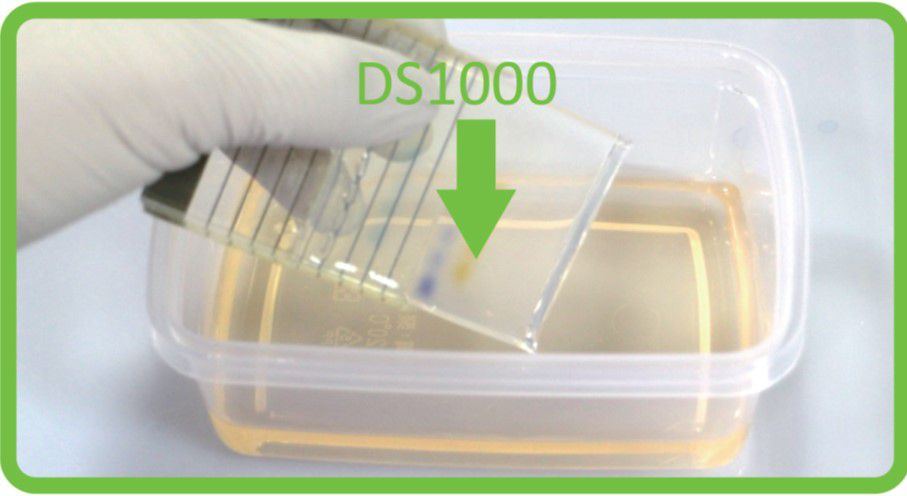
FluoroStain™ DNA Fluorescent Staining Dye
Excellent for post staining
Sensitivity up to 0.04 ng DNA
A safe alternative to EtBr
Suitable for blue or UV light
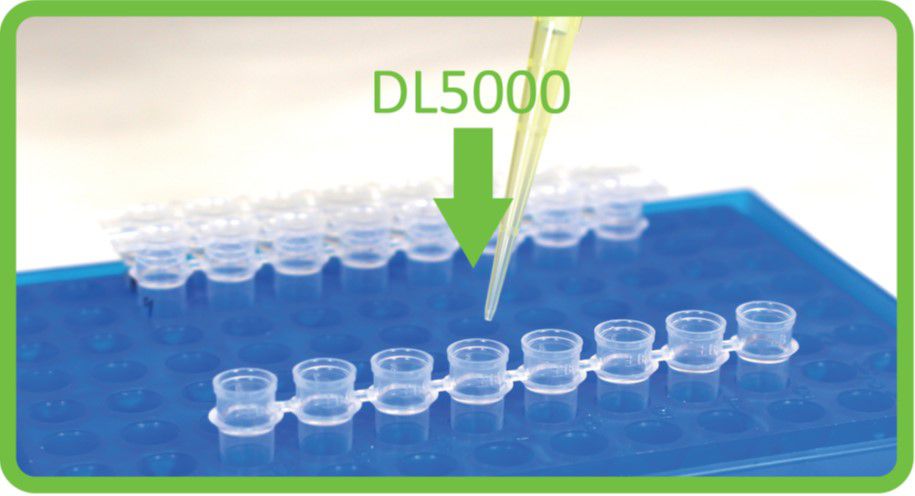
FluoroDye™ DNA Fluorescent Loading Dye
Excellent for premix with DNA sample
Sensitivity up to 0.14 ng DNA
Safety dye
Convenience - monitor the electrophoresis in real-time
Alternative Products
These other products might interest you